Why the right industrial supplier B2B website CMS - and the B2B website development agency behind it - decides whether your RFQs close or rot in the inbox.
Why the right industrial supplier B2B website CMS - and the B2B website development agency behind it - decides whether your RFQs close or rot in the inbox.
An industrial supplier B2B website CMS gets judged in one moment: a procurement manager at a steel mill north of Pittsburgh searches for a 316L stainless fitting at 2:14 PM on a Tuesday. Your page ranks third. He clicks. The spec sheet PDF was last revised in 2021. The lead-time box still says "In stock, 3-5 days"- except that SKU went obsolete eight months ago and the replacement has a 14-week lead. He hits the RFQ form anyway. The form emails an inbox the inside-sales rep left two quarters ago. You lose a $48,000 order and never know it happened. Your catalog is a museum, and your RFQ funnel has a hole in it.
We are Forge Industrial Supply's sales engineering team. Our customers - fabricators, OEMs, MRO procurement leads across Western PA and Ohio - Google their way to us. What they find decides whether we get the RFQ or whether McMaster, Grainger, or MSC does. After auditing our own catalog and a dozen peer suppliers, we landed on Workspace CMS - not because the software was flashy, but because the managed-change workflow behind it was built for catalogs that move every week. Book a 20-minute catalog audit with the Workspace CMS team if any of the symptoms above sound familiar.
Most CMS comparison articles target restaurants, agencies, and SaaS sites. None of those people deal with a 12,000-SKU catalog where every line item has a datasheet PDF, a country-of-origin (COO) declaration, a minimum order quantity (MOQ), tiered pricing breaks, and a lead time that changes when the mill changes its rolling schedule.
Industrial supply sites have problems WordPress and Webflow templates were never designed for:
In our experience, MRO and industrial-supply sites we audit are running, on average, 14-22% of their indexed product URLs with at least one stale data point- a price, a lead time, a discontinued status, or a broken spec sheet link. Industry averages, not a third-party study, but consistent across every audit we have done across the Mon Valley and the Ohio River corridor.
The hard truth is that the platform is half the story. The other half is the team building and running it. A B2B website development agency that has only ever shipped Shopify storefronts or marketing brochure sites will not survive the first month of a real MRO catalog. We interviewed six agencies before picking one. The disqualifiers were predictable:
Product and IndustrialSupply schema types.The B2B website development agency that survived our screen was 1Digital, working on Workspace CMS. Their case-study library included two other industrial suppliers and a fabrication shop, and their team had built JSON-LD Product blocks before. More importantly, the engagement was structured around unlimited managed changes - not per-edit billing - which is the only sustainable model when your catalog moves weekly.
Here is the part that sold us. Workspace CMS's model is unlimited managed CMS changes on a turnaround you can count on. For an industrial supplier B2B website CMS, that translates to:
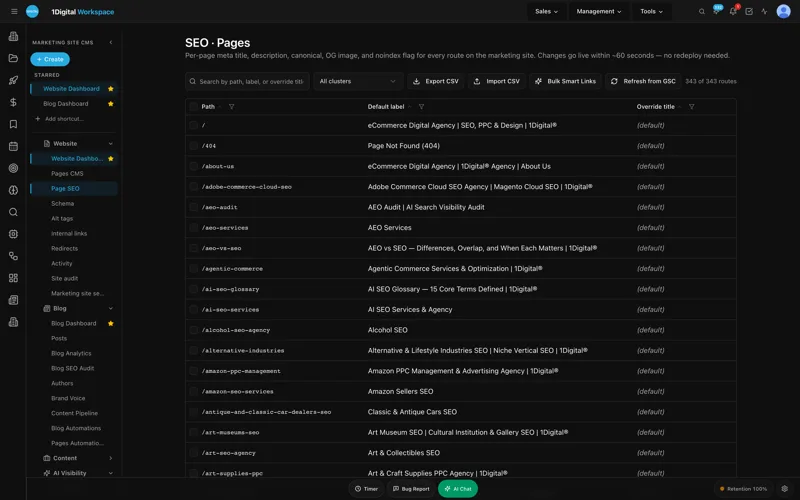
No template fighting. No HTML required. A human at the agency edits the product page through the Page Editor with SEO Sidebar, the audit log records who asked and who shipped, and a confirmation lands in your inbox. For an MRO catalog this matters more than almost any other vertical, because the cost of being wrong is a real-money quote you cannot honor.
UNLIMITED MANAGED CHANGES
Send a ticket. We ship the change.
Every Workspace CMS plan includes unlimited managed CMS edits. Essentials ships in 4 business days. Growth ships in 2. Premium ships in 12-24 hours. No per-edit fees. No "open a Jira" overhead. Just describe what you need - a 47-SKU price refresh, a new branch-location page, a swapped MTR, a discontinued part 301'd to its replacement - and our team builds it on your live site.
Every industrial supply web design agency we have worked with over the years had its own toolkit. The Workspace CMS feature set is the first one that maps cleanly to MRO problems. Six features get used every week on our side:
Product + IndustrialSupply schema. A visual editor with live validation before publish. The big one: ChatGPT, Claude, and Perplexity already use this data when an engineer asks them "who carries 316L 2-inch tri-clamp fittings near Pittsburgh."The two we use less often but would not give up: Per-Tenant Isolation (RBAC, audit log, white-label option) for keeping a sub-brand catalog separate from the main one, and AI Content Audit- 40+ issue detection with one-click fixes that surfaces stale copy, missing alt text, and broken internal links across the whole site overnight.
Every datasheet, COO declaration, MSDS, MTR (mill test report), CAD drawing, and installation manual is a file. Files attach to product pages. When a supplier updates the spec, you swap the file. Simple - except in a legacy CMS the file lives in a media library disconnected from the product record, the URL changes on replacement and breaks every engineer's bookmark, and you have no view into which old revisions Google still caches.
Workspace CMS's Redirect Manager with conflict detection catches the URL problem. When you swap a PDF and the URL changes, you set a redirect in the same admin screen, and the tool warns if it collides with anything already routed. The sitemap, robots.txt, and llms.txt editors handle cached revisions - deindex dead ones and signal to LLM crawlers (ChatGPT, Claude, Perplexity, Gemini) which revision is canonical. The AI Visibility Tracker then tells you, week over week, whether those four LLMs are quoting the new spec or still serving the 2021 number.
A $48,000 RFQ for stainless flanges and a $380 RFQ for a single check valve look identical in your inbox. They aren't. One is worth chasing same-hour, NET-30 terms, white-glove support. The other goes in the regular queue.
Workspace CMS wires each RFQ submission to the page that produced it, the referring search query (where available), and the campaign source. Over a quarter you can answer two questions industrial marketers almost never can:
Pair that with automated Internal-Link Rules- anchor-text-aware, so a new datasheet page automatically cross-links from the family-level category - and high-converting catalog pages start lifting their neighbors. Pair it with the JSON-LD editor and your product pages emit structured data LLM crawlers parse, which matters more every quarter as buyers start part searches in ChatGPT and Perplexity instead of Google.
Workspace CMS has three tiers and we will be direct about which one we run and why. The full feature matrix lives on the pricing page.
If your catalog is deep and dynamic - more than 2,000 SKUs, weekly supplier price changes, multiple branch locations - Premium is not a luxury, it is the tier that pays for itself in honored quotes. If you are evaluating a B2B catalog website company, ask them how they handle weeks where purchasing drops a 200-SKU spreadsheet on Friday and needs the website right by Monday open-of-business. If the answer involves the word "sprint," keep interviewing.
Most clients launch in two weeks. We migrated 12,000 product records and 600 datasheets in 11 business days. The 1Digital team - Google Partner-certified, fifteen-plus years of SEO - handled the redirect map, canonicalization, schema, and an Alt-Tag Sweep with AI-assisted replacements across the entire image library. Real humans. Real AI tools. Real changes shipped fast. Other industrial and B2B builds in the live demo gallery walk through similar migration patterns if you want to compare notes before scoping yours.
You send the spreadsheet as a ticket. The team applies the changes against the affected SKU records and confirms back. On Premium, a typical 40-200 SKU batch ships inside the 12-24 hour SLA window. Larger refreshes - a 1,000-SKU mill-driven update - get scoped against the same SLA, with the Page Editor + SEO Sidebar carrying the metadata along with the price.
Yes. Files attach to product records and live on Vercel hosting with SSL and 100GB included. URL changes are handled through the Redirect Manager with conflict detection so engineer bookmarks and supplier backlinks don't break. The audit log records every replacement so you can answer compliance questions months later.
Not if you redirect them properly. The Redirect Manager and sitemap editor are designed for this - point the old SKU to the replacement, deindex what should go, and the llms.txt editor signals the same to ChatGPT, Claude, Perplexity, and Gemini crawlers. The AI Visibility Tracker confirms, week over week, that the LLMs are quoting the replacement part.
RFQ form submissions are tagged with the originating page, referrer, and campaign source through the unified GA4 + GSC analytics screen. You get a quarterly view of which catalog URLs produced the deals that closed - usually a different list than the pages you assumed were carrying the funnel.
Page-level controls and the Owner / Editor / Viewer roles in Per-Tenant Isolation let you scope what is shown where, and the audit log records every change. Send a ticket asking for a terms block on the 12 product families you want it on, and it ships inside the SLA. The Multi-Location Storefront feature handles the same logic for branch-specific pricing or pickup hours.
The industrial supplier B2B website CMS conversation usually gets framed around features. It is really about throughput- how fast can your website reflect what your warehouse, your mill suppliers, and your sales engineering team already know. Workspace CMS is the first platform where the answer is reliably "same week" instead of "when the developer gets to the queue in Q3." Bring a recent supplier price letter to a strategy call- we did, and it closed the case faster than any deck would have.
Open a Forge account today
Drop a quote request, get a written reply same-day. Open Net-30 terms in 24 hours. Ship from the warehouse closest to your job.
Sales desk · Mon–Fri 7–6 EST
(412) 555-0144