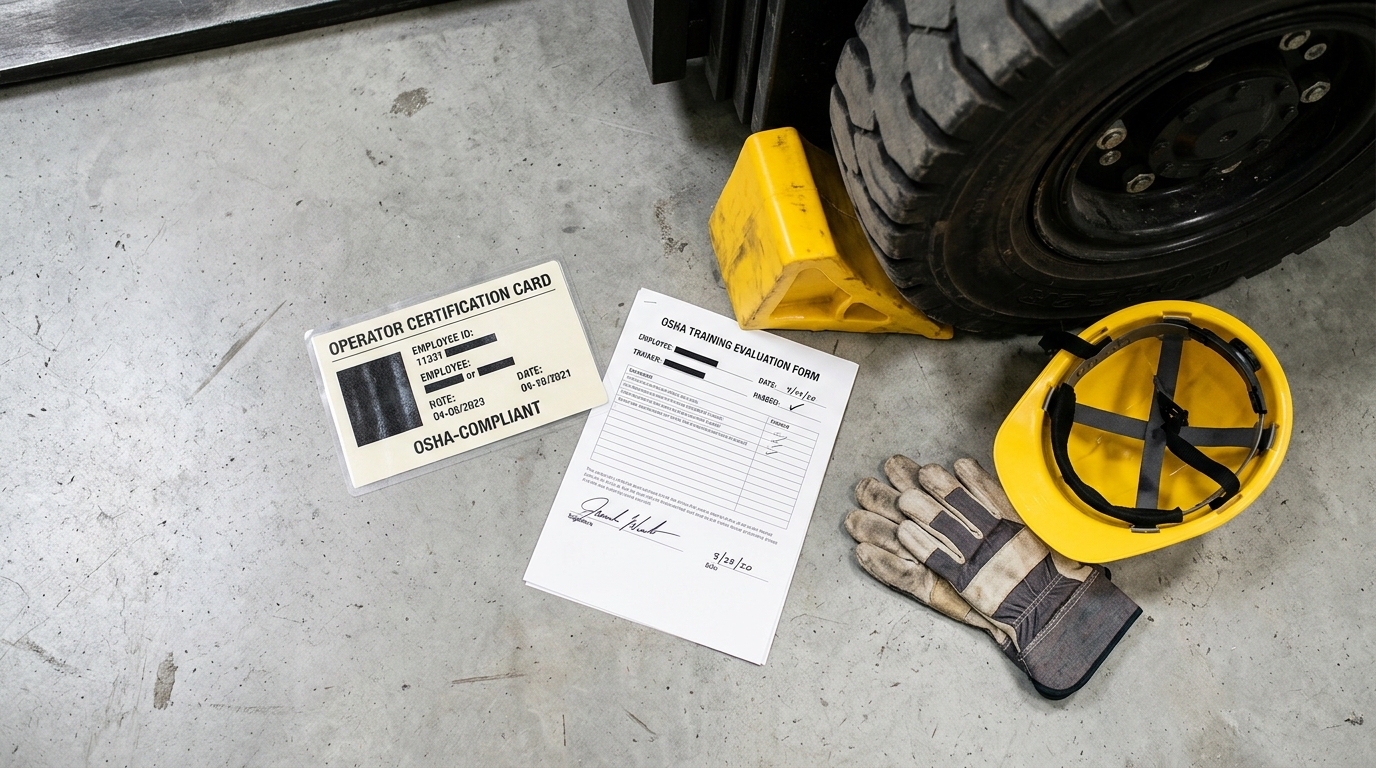
OSHA mandates formal instruction, hands-on training, and a documented evaluation before any operator drives a forklift unsupervised. Here's what managers must know to stay compliant and avoid costly violations.
OSHA mandates formal instruction, hands-on training, and a documented evaluation before any operator drives a forklift unsupervised. Here's what managers must know to stay compliant and avoid costly violations.
OSHA's forklift safety training requirements under 29 CFR 1910.178(l) mandate that every powered industrial truck operator receive formal instruction, practical training, and a performance evaluation before operating a forklift unsupervised. Non-compliance carries penalties up to $16,131 per serious violation - and repeat violations can reach $161,323.
If you manage a warehouse, distribution center, or manufacturing facility, forklift safety isn't optional paperwork. It's a federal obligation with real financial and human consequences. A 2024 Bureau of Labor Statistics report found that powered industrial truck incidents caused approximately 8,000 injuries and 85 fatalities annually in the United States. Getting training right protects your people and your operation.
Here's exactly what the law requires and how to build a training program that actually holds up to inspection.
The governing standard is 29 CFR 1910.178(l) for general industry. Construction worksites fall under 29 CFR 1926.602, and maritime operations have their own separate standards. Most warehouse and distribution managers work under the general industry rule, so that's the framework to know cold.
The standard breaks training into three required components:
All three components are required. A certificate from an online-only course does not satisfy OSHA's standard unless it is paired with workplace-specific practical training and a supervisor evaluation.
OSHA requires that training be conducted by a person with knowledge, training, and experience to train operators and evaluate their competence. The standard does not require trainers to hold a specific license or third-party certification. A qualified internal supervisor or safety manager can legally conduct forklift training - provided they genuinely have the expertise to do so.
That said, many organizations use certified third-party trainers for initial certification and then handle refresher evaluations internally. Either approach is compliant when documented correctly.
The standard lists exact topics that must be covered. Skipping even one creates a compliance gap. Required training topics include:
One of the most common compliance mistakes managers make is treating initial certification as a lifetime credential. OSHA is explicit: refresher training and re-evaluation are required in specific circumstances.
Many safety consultants recommend a 3-year recertification cycle as a best practice even when none of the mandatory triggers have occurred. This isn't an OSHA number - it's an industry standard that has become common in high-quality safety programs.
OSHA requires employers to certify that training and evaluation have been completed. Your documentation must include:
Keep these records for the duration of each employee's tenure, plus a reasonable period after separation. OSHA inspectors will ask for them. Missing or incomplete records - even when training actually happened - can result in citations because you cannot prove compliance without documentation.
OSHA's forklift standard is one of the most frequently cited standards in general industry. These are the failure patterns that show up most often during inspections:
A compliant program follows this sequence for every operator:
Twenty-two states and two territories operate OSHA-approved State Plans with their own enforcement authority. States like California (Cal/OSHA), Michigan, and Washington have forklift training rules that are at least as strict as federal OSHA - and in some cases stricter. California's Title 8 regulations, for example, include specific operator licensing requirements for certain worksites.
If your facility operates in a State Plan state, verify your program against both the federal standard and the applicable state standard. Federal compliance alone may not be sufficient.
Forklift training is not a checkbox. It's a structured, documented, equipment-specific process that OSHA will scrutinize closely during an inspection - especially after an incident. A compliant program covers all required topics, uses qualified trainers, includes real hands-on evaluation, and maintains complete records for every operator. Build the system now, and it protects your workers and your organization when it matters most.
OSHA does not specify a fixed expiration period for forklift certification. Instead, refresher training is required when specific triggers occur - such as an accident, a near-miss, unsafe observed behavior, or a change in equipment type or workplace conditions. Most safety professionals recommend a 3-year proactive recertification cycle as a best practice, even without a triggering event.
No. Online or computer-based instruction satisfies the formal instruction component of OSHA's training requirement, but it does not replace mandatory hands-on practical training and a documented performance evaluation in the actual workplace. Operators who complete only an online course are not OSHA-compliant until the practical and evaluation components are also completed and documented.
Yes. OSHA requires that training be specific to the type of truck the operator will use. There are seven powered industrial truck classes under the standard. An operator certified on a Class I electric counterbalanced forklift must receive additional training and evaluation before operating a Class II narrow-aisle truck, a Class IV internal combustion sit-down truck, or any other class they haven't been evaluated on.
As of 2026, OSHA's maximum penalty for a serious violation is $16,131 per violation. Willful or repeat violations can reach $161,323 per violation. Training-related citations are commonly issued as serious violations, and inspectors can cite multiple violations - for example, one per untrained operator - which means penalties compound quickly in larger workforces.
The employer bears full legal responsibility under OSHA's standard. It is the employer's obligation to ensure that every forklift operator receives compliant training, that training is conducted by a qualified person, and that all required documentation is maintained. An employee's failure to disclose prior training or to perform safely does not transfer liability away from the employer.
Open a Forge account today
Drop a quote request, get a written reply same-day. Open Net-30 terms in 24 hours. Ship from the warehouse closest to your job.
Sales desk · Mon–Fri 7–6 EST
(412) 555-0144