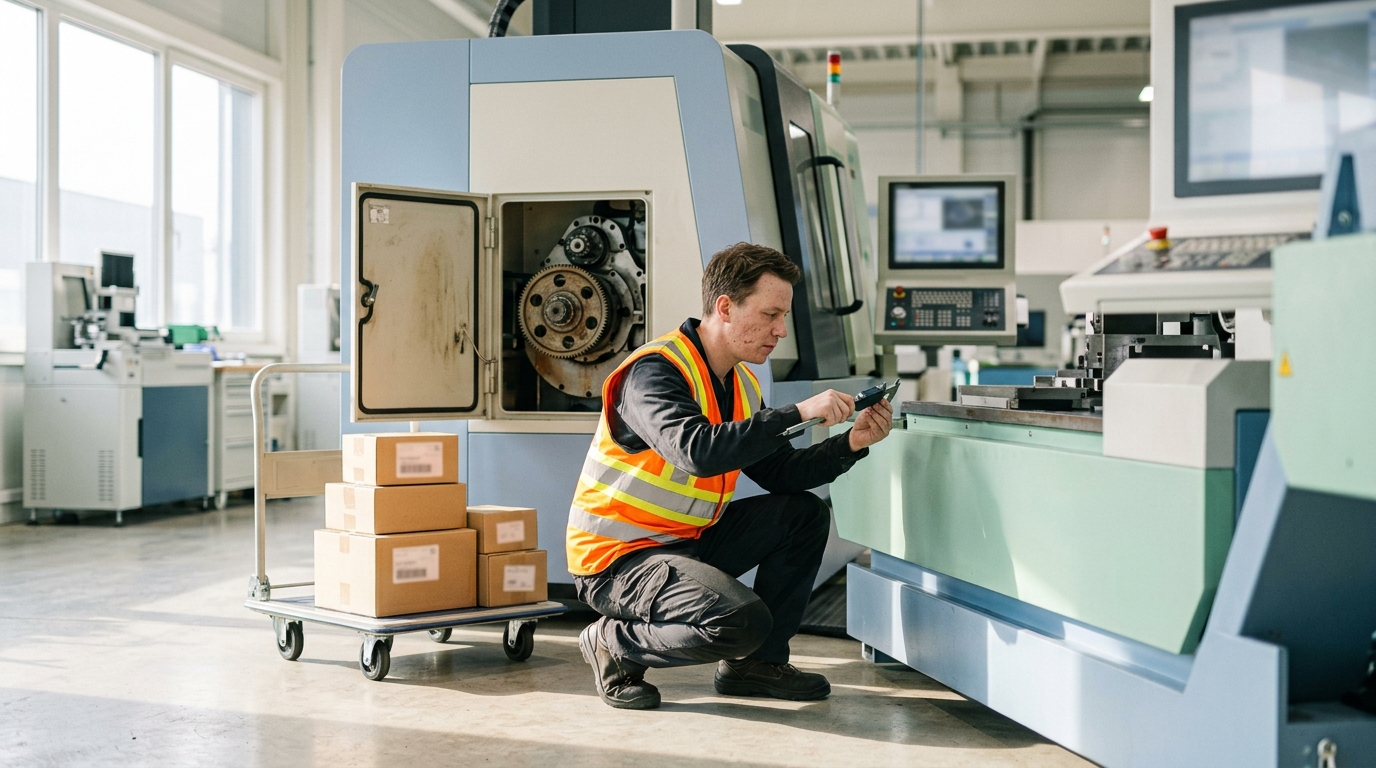
Replacing industrial equipment too soon wastes capital; repairing it too long drains production budgets. This decision framework uses the 50% Rule and Total Cost of Ownership analysis to guide the right call.
Replacing industrial equipment too soon wastes capital; repairing it too long drains production budgets. This decision framework uses the 50% Rule and Total Cost of Ownership analysis to guide the right call.
Replace industrial equipment when total repair costs exceed 50% of replacement value, downtime losses outpace repair savings, or the machine no longer meets current safety and efficiency standards. Repair when the asset is under 40% of its useful life, parts are readily available, and the failure is isolated and non-recurring.
Making the wrong call on this decision costs manufacturers real money - either through premature capital expenditure or through the slow hemorrhage of chronic repair bills and lost production hours. Here is a structured framework for getting it right.
Maintenance managers have used the 50% Rule as a baseline for decades: if the cost of a single repair exceeds 50% of the current replacement cost of the equipment, replacement is the stronger financial move. The logic is straightforward - at that threshold, you are spending significant capital on an asset that is already demonstrating structural vulnerability, without resetting the reliability clock the way a new unit would.
But the 50% Rule is a starting point, not the whole answer. Apply it alongside a Total Cost of Ownership (TCO) analysis that captures:
These signals, individually or combined, indicate that replacement delivers better long-term value than continued repair:
Repair is the right answer more often than capital budgets want to admit. These conditions favor repairing over replacing:
Facilities running predictive maintenance programs- using vibration analysis, thermal imaging, and oil analysis - make this decision with real evidence rather than intuition. Vibration data trending upward over six months on a gearbox tells you failure is coming before it happens. That lead time lets you price both repair and replacement options, check parts inventory, and schedule the work during planned downtime instead of scrambling during an unplanned stoppage.
In 2026, IoT sensor costs have dropped enough that even mid-sized manufacturers can deploy condition monitoring across critical assets. The data payoff is exactly this kind of decision support: you move from reactive gut calls to scheduled, evidence-based choices.
Run every major repair-or-replace decision against a 5-year TCO model. A machine that costs $80,000 to replace might look expensive today. But if it saves $12,000 per year in energy costs, eliminates $8,000 per year in recurring repairs, and reduces downtime losses by $15,000 per year, the cumulative 5-year benefit is $175,000 - more than double the replacement cost. Laid against a repair option costing $35,000 today with the same failure pattern likely to repeat, replacement wins decisively.
Build your TCO model with these five inputs:
Maintenance managers frequently default to repair simply because replacement isn't in the current capital budget. This is understandable, but present the TCO data to finance leadership with downtime costs quantified. A $40,000 repair that delays a $90,000 replacement by 18 months might make sense. A $40,000 repair on equipment that will require another $30,000 repair within 12 months - while losing $20,000 per month in production efficiency - does not survive scrutiny when the numbers are on the table.
Use the data to have the right conversation, not to avoid it.
The most widely used benchmark is the 50% Rule: if a single repair costs more than 50% of the equipment's current replacement value, replacement is the financially sound choice. Pair this with a 5-year Total Cost of Ownership analysis that includes downtime, energy costs, and parts availability to make the final call.
Multiply your facility's hourly production output value by the number of downtime hours, then add labor costs for idle workers, expedited shipping for parts, and any customer penalty clauses triggered by missed deliveries. In heavy manufacturing, unplanned downtime commonly runs $5,000–$20,000 per hour in direct and indirect losses.
When an asset has consumed more than 75% of its rated service life, replacement planning should begin even if the unit is still operational. Beyond that threshold, failure frequency typically accelerates, parts become scarcer, and the opportunity cost of continued repair exceeds the savings from deferring capital expenditure.
Yes, in many cases. If a modern replacement unit offers a verified 20% or greater reduction in energy consumption, calculate the annual dollar savings against the replacement cost. A 36-month or shorter payback period through energy savings alone - without accounting for reduced maintenance costs - is a strong financial justification for replacement independent of equipment condition.
Parts availability is a critical and often underweighted factor. When an OEM discontinues a product line, aftermarket lead times can stretch to 8–16 weeks and quality assurance becomes harder to guarantee. If your facility cannot tolerate that exposure, replacement with a currently supported model eliminates the supply chain risk and often comes with a new OEM warranty that resets your maintenance baseline.
Open a Forge account today
Drop a quote request, get a written reply same-day. Open Net-30 terms in 24 hours. Ship from the warehouse closest to your job.
Sales desk · Mon–Fri 7–6 EST
(412) 555-0144