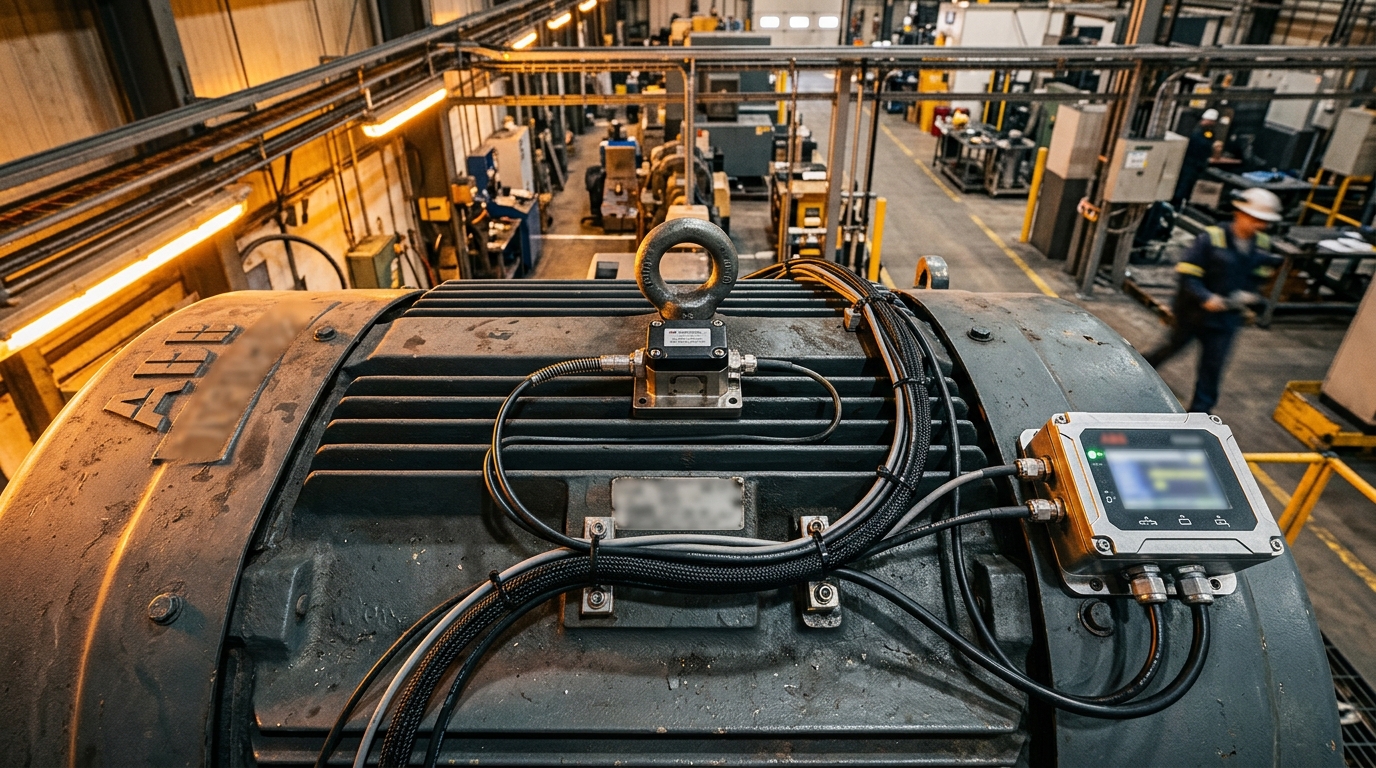
Smart sensors have fundamentally shifted industrial maintenance from reactive firefighting to precision-driven prediction - cutting unplanned downtime by up to 50% and reducing maintenance costs by 25–30% in heavy manufacturing environments. These devices don't just collect data; they interpret it in real time, triggering alerts before a bearing fails, a motor overheats, or a conveyor belt degrades past its safe operating threshold.
If you run a plant, manage a fleet of industrial equipment, or oversee a facilities operation, smart sensors are no longer optional infrastructure. They are the foundation of competitive maintenance strategy in 2026.
What Makes a Sensor "Smart"
A traditional sensor measures one variable - temperature, pressure, vibration - and sends a raw signal to a control system. A smart sensor does much more. It includes onboard processing capability that filters noise, normalizes data, runs edge-level analytics, and communicates via industrial protocols like IO-Link, OPC-UA, or MQTT without requiring a dedicated gateway for every unit.
Modern smart sensors from manufacturers like Bosch Rexroth, Honeywell, Siemens, and IFM Electronic combine multiple measurement types in a single housing. One IFM VSA001 vibration sensor, for example, monitors acceleration, velocity, and temperature simultaneously while running onboard FFT (Fast Fourier Transform) analysis to detect imbalance, misalignment, and bearing defects before they escalate.
That onboard intelligence is what makes the difference. Edge processing reduces latency from seconds to milliseconds, lowers bandwidth consumption by sending only anomaly flags rather than raw streams, and keeps systems operational even when cloud connectivity drops.
The Four Core Applications in Industrial Maintenance
1. Predictive Maintenance on Rotating Equipment
Motors, pumps, compressors, and fans are the heartbeat of any plant. Smart vibration and acoustic sensors mounted directly on these assets track signature changes over time. A shift in the vibration frequency spectrum - specifically at multiples of the running speed - signals early-stage bearing wear. Maintenance teams receive an alert days or weeks before failure, scheduling repairs during planned downtime instead of scrambling after a catastrophic breakdown.
2. Thermal Monitoring of Electrical Panels and Drives
Thermal imaging sensors and infrared thermocouples now integrate directly into MCC (Motor Control Center) panels and variable frequency drives. These sensors flag hot spots caused by loose connections, overloaded circuits, or failing capacitors - all of which are leading causes of electrical fires in industrial facilities. Continuous thermal monitoring replaces the traditional quarterly infrared inspection, providing 24/7 coverage at a fraction of the labor cost.
3. Fluid and Lubrication Quality Sensing
Oil condition sensors from companies like Hydac and Parker Hannifin measure viscosity, water content, particle count, and dielectric constant in real time. Rather than changing oil on a fixed calendar schedule, plants now change it only when the oil actually degrades - extending oil change intervals by 40–60% in hydraulic systems and reducing lubricant consumption significantly across large fleets.
4. Structural Health Monitoring
Wireless strain gauges and accelerometers embedded in bridges, cranes, and structural steel continuously measure load cycles and micro-deformations. This data feeds directly into digital twin models, letting engineers predict fatigue life with far greater accuracy than periodic manual inspection allows.
Smart Sensors vs. Traditional Maintenance Approaches: 5 Key Differences
- Data frequency: Smart sensors deliver continuous or high-frequency sampling (up to 25,600 samples/second on high-end units); traditional inspection happens quarterly or monthly.
- Failure lead time: Smart sensor systems detect faults 2–8 weeks before failure; reactive maintenance detects problems only after failure occurs.
- Labor dependency: Smart sensors operate autonomously; traditional condition monitoring requires skilled technicians on-site for each data collection event.
- Cost structure: Smart sensors carry higher upfront capital cost (typically $150–$2,000 per sensor node depending on capability) but reduce total maintenance spend by 25–30% over a 3-year horizon.
- Integration depth: Smart sensors feed CMMS platforms like IBM Maximo, SAP PM, or Limble CMMS in real time; traditional data sits in paper logs or siloed spreadsheets.
The Role of IIoT Platforms in Making Sensor Data Actionable
Raw sensor data without context is noise. The real value emerges when smart sensors connect to an Industrial Internet of Things (IIoT) platform that aggregates, visualizes, and analyzes streams from hundreds or thousands of assets simultaneously.
Platforms like PTC ThingWorx, Siemens MindSphere (now Siemens Insights Hub), and GE Vernova's Asset Performance Management suite apply machine learning models trained on historical failure signatures to score asset health in real time. A pump that scores below a configurable health threshold - say, 72 out of 100 - automatically generates a work order in the connected CMMS without human intervention.
This closed-loop automation is the practical realization of Industry 4.0 principles. Maintenance shifts from event-driven to condition-driven, with planning horizons that stretch weeks ahead instead of hours.
Wireless Protocols and Connectivity Infrastructure
Deploying smart sensors at scale requires choosing the right communication protocol for the environment. The major options in 2026 each carry distinct trade-offs:
- WirelessHART (IEC 62591): Mesh network, self-healing topology, excellent for process plants with dense equipment clusters. Latency around 250ms - acceptable for most condition monitoring use cases.
- IO-Link Wireless: Deterministic, sub-5ms latency, ideal for high-speed automation cells where timing precision matters.
- LoRaWAN: Long range (up to 15km in open environments), low power, suited for large outdoor facilities like tank farms, pipelines, and mining operations.
- 5G Private Networks: High bandwidth, ultra-low latency (under 1ms), increasingly deployed in Tier 1 automotive and semiconductor plants where dense sensor deployments require massive data throughput.
The connectivity layer is not an afterthought - it determines whether sensor data arrives reliably, at the right frequency, and with sufficient security to meet industrial cybersecurity standards like IEC 62443.
Calculating the Business Case
A straightforward ROI calculation for a mid-size manufacturing plant with 200 monitored assets typically looks like this: upfront sensor hardware and installation runs $80,000–$150,000; IIoT platform licensing adds $30,000–$60,000 per year. Against that, a single prevented unplanned shutdown on a critical production line - which commonly costs $50,000–$500,000 in lost production, emergency labor, and expedited parts- recovers the entire investment in one event.
A 2025 study by the McKinsey Global Institute found that predictive maintenance programs enabled by smart sensors reduce equipment breakdowns by 70% and lower maintenance costs by 25% on average across discrete and process manufacturing sectors. Plants that reached full deployment maturity reported payback periods of 12–18 months.
Implementation Roadmap: Where to Start
- Asset criticality ranking: Identify the 10–15 assets whose failure causes the most production impact or safety risk. Start sensor deployment there, not everywhere at once.
- Baseline data collection: Run sensors for 4–8 weeks in monitoring-only mode before setting alert thresholds. Establish what "normal" looks like for each specific asset in its operating context.
- CMMS integration: Connect sensor alerts directly to your work order system. Manual data entry between platforms destroys the speed advantage smart sensors provide.
- Technician training: Sensors surface data; people interpret it. Invest in training maintenance teams to read vibration spectra, thermal maps, and oil analysis reports. The human layer remains essential.
- Expand and iterate: After validating ROI on priority assets, scale the program using lessons learned. Standardize on one or two sensor families to simplify procurement and calibration management.
The Road Ahead
Smart sensors are becoming smaller, cheaper, and more capable every product generation. Energy harvesting technology - pulling power from vibration, thermal gradients, or ambient RF - is eliminating the battery replacement burden that slowed wireless sensor adoption in hard-to-access locations. AI models running directly on sensor microcontrollers are enabling autonomous fault classification at the edge, without any cloud dependency.
Industrial maintenance in 2026 is not just smarter - it's fundamentally restructured around continuous, data-driven insight. The plants that embraced smart sensor programs early are running with demonstrably fewer failures, lower costs, and higher equipment availability than those still relying on calendar-based PM schedules. The gap between the two groups is widening.
What is the difference between a smart sensor and a traditional sensor?
A traditional sensor measures one physical variable and sends a raw analog or digital signal to a control system. A smart sensor adds onboard processing, self-calibration, multi-parameter measurement, and direct communication via industrial protocols like IO-Link or OPC-UA - enabling edge-level analysis and autonomous fault detection without external computing hardware for every unit.
How much do industrial smart sensors cost?
Smart sensor node costs range from approximately $150 for basic wireless temperature or vibration monitors to $2,000 or more for multi-parameter units with onboard FFT analysis and industrial-grade enclosures. Total deployment cost including installation, connectivity infrastructure, and IIoT platform licensing typically runs $80,000–$200,000 for a 200-asset mid-size plant, with payback periods of 12–18 months based on prevented downtime savings.
Which industries benefit most from smart sensor-based maintenance?
Oil and gas, automotive manufacturing, food and beverage processing, pulp and paper, and pharmaceutical manufacturing see the highest ROI because they operate continuous production assets where a single unplanned shutdown costs tens of thousands to hundreds of thousands of dollars per hour. Mining and utilities also report strong returns due to remote asset locations where traditional manual inspection is costly and logistically difficult.
Do smart sensors work without internet connectivity?
Yes. Smart sensors with edge processing capability analyze data and generate alerts locally, operating independently of cloud connectivity. Connectivity to an IIoT platform enhances functionality - enabling fleet-wide analytics and machine learning models - but the core fault detection function runs at the sensor or local gateway level, maintaining operation during network outages.
How do smart sensors integrate with existing CMMS platforms?
Most enterprise CMMS platforms including IBM Maximo, SAP Plant Maintenance, and Limble CMMS support API-based integration with IIoT middleware layers. When a smart sensor detects a fault condition exceeding a configured threshold, the IIoT platform pushes a structured alert to the CMMS, which automatically generates a work order, assigns priority, and notifies the relevant technician - completing the loop from sensor detection to maintenance execution without manual data entry.